
tl;dr 🍬
Last week was a high stakes week for Apple. Marked by political pressure from Trump’s threat of 25% tariffs on iPhones made outside the US, while Fortnite made a surprise return to the App Store and Microsoft blamed Apple and its App Store rules for stalling the release of an Xbox store on iOS.
Meanwhile AI continues to take centre stage as Apple allegedly plans to open up its LLM models to third party developers. And the rumoured Siri LLM overhaul is heavily expected to be going ahead. Interestingly Apple’s former Chief Designer Officer, Sir Jony Ive has joined forces with Open AI to build a wearable AI product. Things are moving fast in this space.
Rounding things off, more iPhone 17 Air rumours suggest concerns over its battery life and leaks suggest that Apple tested a MacBook Pro with an M3 Ultra chip. All this and more in this weeks Mission CMD 🚀
If you’d like to be notified when new issues of Mission CMD go live, type your email address into the widget below and click subscribe. You’ll receive an email when I publish new content to the site, including Mission CMD. And have it delivered straight to your inbox. Thanks for your support!
CMD / Start 🏁

Jony Ive and Open AI’s hardware collaboration
Jony Ive, Apple’s former design chief, has joined Open AI via the former acquisition of Ive’s AI startup, I/O. The deal values Ive’s firm at around $6.5 billion and will see Ive work directly with Open AI to create and design new AI-powered hardware products. It marks a big moment for Apple symbolically as it races to catch up in AI. Seeing its former chief designer, the designer behind the iPhone, join such a big competitor (and partner) is likely to focus the minds of the senior leadership at Apple.
“We are sitting at the beginning of what I believe is the greatest technological revolution of our time. I have a growing sense that everything I’ve learned over the last 30 years has led me to this moment.”
Jony Ive
What’s most fascinating about this story is Ive’s gentle hinting towards stagnation in today’s devices. Not that Ive necessarily suggests the devices we use today aren’t great products. But rather that today’s devices aren’t disruptive or pushing things forward in perhaps the way they once did stating “There has been an absence of new ways of thinking expressed in products.”
AI models are expensive to create and expensive to operate. It’s also difficult to commercialise these models. Open AI hopes to differentiate itself by creating hardware with deep integration with AI. They won’t be the first company to try of course. Ive himself commented on some of the more notable flops: “There have been public failures as well, such as the Humane AI Pin and the Rabbit R1 personal assistant device. “Those were very poor products” said Ive.
Trump Threatens 25% Tariff on Non-U.S. iPhones
In his goal to increase manufacturing in the United States, US President Donald Trump has threatened to slap a 25% tariff on any iPhones sold in the US that aren’t also manufactured in the US. That’s not great news for Apple, and it’s also unlikely to be doable. While the US certainly has the resources to build factories for iPhone production, its workforce lacks the vocational skills required to assemble the quantity needed.
Even if Apple had the workforce, the cost to build the device in the US would be much higher due to wages and lack of scale. It could take a decade or more for Apple to move its manufacturing operations entirely to the US, and the cost of its devices would become cost-prohibitive for consumers. So much so that some analysts, including Ming-Chi Kuo, have suggested that Apple would be better off to simply accept the tariffs and continue to engage with Trump.
California Attorney General Rob Bonta has announced his readiness to take legal action in defence of California-based companies like Apple. He emphasised that his office will closely monitor any resulting policies off the back of these threats and assess the legal standing for a lawsuit if state or corporate rights are violated.
Fortnite returns to U.S. App Store
In a surprise move, Fortnite returned to the US App Store after its developer, Epic Games, claimed that Apple was in breach of a court injunction. Rather than contest this in court after the judge hinted at a heavy handed approach, Apple conceded and approved the app instead.
Apple originally banned Epic Games developer account which kicked off a multi year legal campaign between Apple and Epic. While Apple eventually won on most counts, the one count it lost on was around anti-steering rules. In a nut shell Apple was required to allow developers to communicate offers, pricing and link out to other websites from within their app. Thus allowing a developer to circumvent Apple’s commission for in-app purchases.
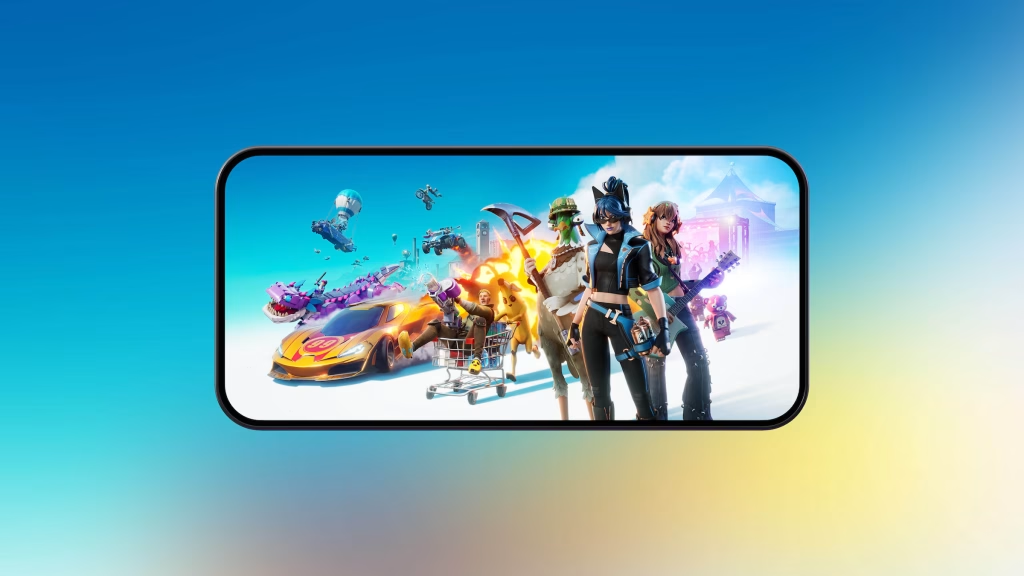
Apple had in its view, complied with that ruling. However its version of compliance allowed Apple to collect a 27% commission on purchases made using links to external sites. Epic disagreed that Apple was in compliance and appealed to the court. The court took Epic’s side and Apple was ordered to stop taking commissions amongst other requirements. Apple has now complied but appealed this ruling to a higher court.
What’s interesting about this case, is that the same judge had ruled that Apple was within its rights to ban Epic Games from the App Store. The fact that Apple had continued to block Epic from the App Store after the injunction was enforced, doesn’t seem to be a violation of the injunction. Its requirements were specifically around anti-steering. Perhaps Apple just didn’t like the optics and felt it was easier to backdown while it appeals the injunction to the 9th circuit. Epic’s CEO seems to be particularly thrilled.
Microsoft weighs in on Epic v Apple
Following the implementation of the injunction against Apple, Microsoft had hoped to be able to launch its Xbox store on the iPhone. However, it is taking a watch-and-wait approach, concerned that Apple is likely to win its appeal to the 9th Circuit. If that were to be the case, any such launch of its Xbox Store would be a waste of time since it would no longer be able to operate in the way that Microsoft had planned.
While the injunction remains in place, Apple is not able to take commissions for external purchases. But if it wins its appeal, it could once again collect commissions, and the Xbox store, Microsoft claims, would no longer be viable.
Microsoft has long sought to enable Xbox app users on iOS to both buy and stream games in the app from the cloud or their other devices. Apple’s policies have restricted Microsoft’s ability to offer these functionalities together; the injunction allows Microsoft to explore this possibility.”
Microsoft via an Amicus Brief in support of Epic Games
Run / Update ⚙️

Apple to Open On-Device AI to Developers
According to Bloomberg, Apple plans to announce an important addition to its developer SDK at WWDC. The ability to use its on-device LLM models. If correct, it would allow developers to make use of Apple’s models within third-party apps. Apple is thought not to be allowing access to its cloud models for now. But this should allow developers to do some interesting things in their apps.
Third-party apps can already take advantage of some existing Apple Intelligence features like Writing Tools and Image Playground. But this expanded SDK would go one step further, allowing developers to create new features in their apps built on Apple’s secure, private on-device models. This would be akin to Gemini Nano for Android, with developer support announced at last week’s Google I/O event.
Siri Overhaul with LLM Integration Underway
It’s fair to say that Apple Intelligence, much like Siri, has gotten off to a shaky start. But unlike the latter, Apple hopes to quickly revamp Apple Intelligence. And at the same overhaul Siri once and for all. Apple is said to be rebuilding Siri from the ground up with deep LLM integration, transforming it into a truly integrated chat bot. Akin to ChatGPT or Google’s Gemini.
Apparently Apple plans to continue to pursue its focus on user privacy by employing differential privacy techniques. Siri will be able to crawl the web and synthesise data for an experience not too dissimilar from ChatGPT. But with a clear focus on privacy, Apple wants to differentiate itself while still offering robust, deeply integrated AI features.
In the interim Apple hopes to have shipped its previously announced Apple Intelligence features for Siri including the ability to take actions in apps and act on your personal context. These features should be shipping within the year but Apple has gone on record as saying more time is needed to complete them.
Safari May Switch to Alternative AI Search Engines
During a recent court testimony, Eddy Cue, Apple’s SVP of services let out an interesting tidbit. Apple is actively exploring how Safari handles search. Likely referencing the rapid transition away from traditional search engines to more useful, personalised search experiences offered by AI.
Cue claimed that in April this year, for the first time ever, the number of searches made in Safari dropped for the first time ever. This change he states, is being driven by AI. Cue did clarify that this isn’t expected to become the default search experience for some time. But it did strengthen Apple’s argument regarding its search deal with Google.
Apple argues that Google should be allowed to continue to pay it for its status as the default search engine on Safari. Per Cue’s argument, traditional search will be of less concern as time goes by, as more and more users will migrate to AI search tools. Meaning they represent less of a competition concern since users are jumping ship.
Launch / CTRL 👨🚀

iPhone 17 Air Leak Hints at battery capacity
Apple’s now long rumoured iPhone 17 Air may come with an ultra slim design. But also an ultra slim battery to go along with it. According to the latest reports, the battery capacity could be as low as 2800mAh. Previous reports have indicated that Apple is using stacked battery technology and that paired with its custom C1 modem, heavy optimisations in iOS and specialised display drivers, battery life should still be all day.
Recently Samsung released its Galaxy S25 edge which has a capacity of 3900mAh and weighing in at 163 grams. If true, the iPhone Air would have a notably smaller battery life even than Samsungs super thin flagship. That said the iPhone Air is expected to be even thinner and lighter at 145 grams. If true, it would be by far the slimmest smartphone in a standard, non-folding form factor.
iPhones have rarely had the highest capacity batteries and yet they do provide great battery life thanks to custom hardware paired with custom designed software. Perhaps Apple’s chip wizards and software team have booked up some special sauce to deliver all day battery life. We’ll have to wait until September to find out.
Apple tested an M3 Ultra MacBook Pro…
An iOS 18 code leak has revealed that Apple internally tested a variant of the MacBook Pro powered by the high-performance M3 Ultra chip. This chip, identified by model codes J514d and J516d, is currently the most powerful chip in Apple’s Silicon lineup, typically reserved for desktops like the Mac Studio (and the loveless Mac Pro).
While the idea of an M3 Ultra MacBook Pro is intriguing, it would almost certainly face significant thermal and power efficiency challenges due to the chip’s high heat output and energy demands. Despite these limitations, the leak carries weight. It has correctly referenced abandoned iPad configurations and verified builds of Apple’s internal diagnostic software, lending further credibility to the possibility that Apple at least explored the idea during prototyping.
I for one would snap one up! There’s always the M5 Ultra…if Apple can defy physics of course 😅
Apple Smart Glasses Targeted for 2026

In yet more information from Bloomberg, Apple allegedly plans to release smart glasses in 2026. More like the Meta Ray-Bans than the Apple Vision Pro. But still built upon visionOS. The device is said to have a heavy focus on AR and user assistance with features like live translation, audio playback, video capture, and providing directions.
If Apple does have some glasses in the works, it would come hot off the heels of Google’s recent announcement of AR-capable smart glasses at I/O. Unlike the Vision Pro or Android XR devices, smart glasses focus less on AR and more on AI. But it seems inevitable that eventually these platforms will converge in time. It’s a case of bringing the technology down to the scale of a reasonably sized pair of glasses. No easy feat and not something we should expect to see for several years. But once the formula is cracked it could be a game changer.
sys.support 📂
If you enjoyed this article and the content I create, please consider subscribing. Tips support me as a content creator and helps to keep the site ad free along with occasional sponsors. Sharing my content helps others to discover it. Your support is very much appreciated🧃

Comments